()
1985 HOUDINI'S NIECE INTERVIEW - MARIE BLOOD
As told to Robert Olson - Abbott's "New Tops Columnist"
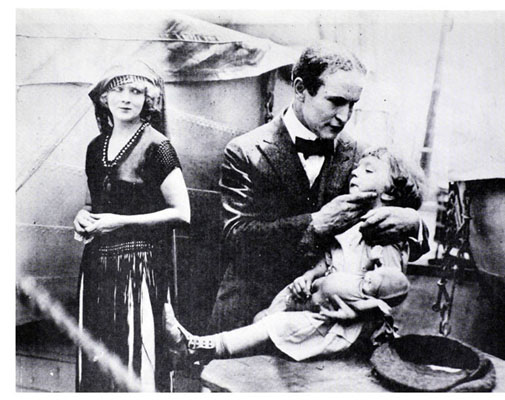
Many people are pleased to be related to famous people and Marie Hinson Blood is the niece of one of the most famous magicians of all time, the renowned escape artist, Harry Houdini. She used to spend weeks at a time at the Houdini residence on West 113th Street in New York City. Uncle Harry, as he was known to her, would spend hours playing with his little niece and take her around the city with him when he was home from his trips around the world. Of all the children born into the Houdini family of relations, Marie is the only one who had her picture taken with him. He was especially fond of her and would send her presents from Europe, such as pretty dresses with matching little shoes.
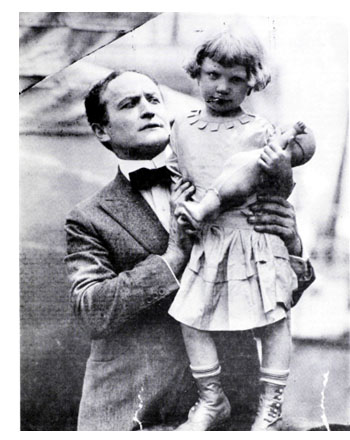 Attendance at a theatre where Houdini was playing was quite frequent. She would be in the audience with her mother and at intermission Houdini would come out on the stage and speak with the audience. "I think I have a little niece here," he would say. Marie's mother would be fixing her dress and, at the proper moment, she would run down the aisle and shout, "Here I am. Uncle Harry! Here I am!" Up the steps to the stage she would go and Houdini would grab her and pick her up and toss her into the air and give her a big hug. Of course, the audience just ate this up and loved it as much as Houdini and Marie. Then Harry would put her down and introduce her with, "This is Marie. I think she is going to do something for us today." Stretching out her little arms in both directions, Marie would do her version of the shimmy dance! So Marie Hinson Blood can honestly say she was in show business and performed with her uncle, Harry Houdini!
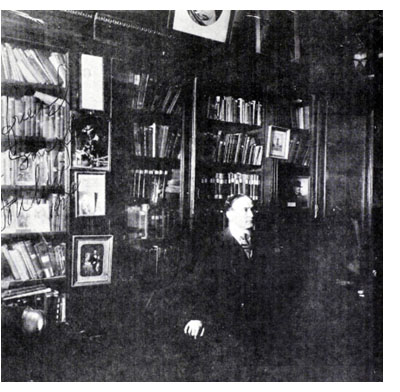
278 West 113th Street, New York City is familiar to many of us not only as the home address of Harry Houdini but the address he used as a publishing house for many of his publications. These brownstone houses' were several stories high and from the front outside door one could go downstairs to the first floor or upstairs to the second. Marie remembers the Houdini residence well, telling us that on the first 'floor was a large, dining room and the kitchen. The second floor was the library and bedrooms. The third floor contained the maid's room, her grandmother's room, and so on.
In this beautiful home the Houdini's had a curio cabinet filled with beautiful and expensive articles from all over the world. One day Uncle Harry took her to it and told her she could have anything she wanted from it. Her eyes settled on a little baby buggy in a woven design with a movable top, carved out of white ivory. Other items might have been worth more but a little six year old girl was thrilled with the buggy. It once had a cloth pillow inside it, which has long since deteriorated.
Other items from the Houdini household now in the Blood collection include a large porcelain vase presented to Houdini by the King and Queen of Austria; a sterling silver coffee and tea serving set; and a silver dome cover. Handwork, made by Beatrice Houdini, includes a cloth motto which states: "A house with a hearth, and books worthwhile, and a garden of flowers, bring a cheery smile."
Also made by Bess is a picture of a white heron standing on one leg in a lake with flowers and birds included. These are in various colors of threads in hand-stitched embroidery.
The book shelf has several magic books, such as "Old and New Magic" by Henry Ridgely Evans, two copies of "The Unmasking of Robert-Houdin" by Houdini, "Houdini and Conan Doyle", "A Magician Among the Spirits" by Houdini, "The Life of Sir Arthur Conan Doyle", and "Latest Magic" by Professor Hoffman. Two recent publications include "The Original Houdini Scrap Book" by Walter B. Gibson and "Houdini - His Legend and His Magic" by Doug Henning and Charles Reynolds. The latter book was made up of memorabilia purchased from Marie's sister who sold her collection to Doug Henning. There were duplicates that both sisters had, but there are several items in the Blood collection that were not in her sisters.
 Outstanding in this collection of books is one named "Our Boy's Chatterbook" containing games and pastimes for children on rainy days. These books were very popular in the last century. On the flyleaf there are several inscriptions, beginning with:
Harry Houdini Hinson (Marie's brother) whom this book was given to died February 15, 1934 at the age of twenty-one. His sister Marie Hinson owns the book at present. Date: September 20, 1934. This book was given to the nephew of Beatrice and Harry Houdini, to Harry Houdini Hinson. Christmas 1926 by Beatrice Houdini, widow of Houdini who died October 31, 1926. Merry Christmas to Harry Houdini Hinson from his Aunt Beatrice, 1926. A Merry Christmas to Erich Weiss from Herman. December 25, 1884."
Outstanding in this collection of books is one named "Our Boy's Chatterbook" containing games and pastimes for children on rainy days. These books were very popular in the last century. On the flyleaf there are several inscriptions, beginning with:
Harry Houdini Hinson (Marie's brother) whom this book was given to died February 15, 1934 at the age of twenty-one. His sister Marie Hinson owns the book at present. Date: September 20, 1934. This book was given to the nephew of Beatrice and Harry Houdini, to Harry Houdini Hinson. Christmas 1926 by Beatrice Houdini, widow of Houdini who died October 31, 1926. Merry Christmas to Harry Houdini Hinson from his Aunt Beatrice, 1926. A Merry Christmas to Erich Weiss from Herman. December 25, 1884."
Houdini was just ten years old when this book was given to him. The last entry is in his own hand: "This book given to me by my brother Herman and his wife. The only thing I have left of the days of long ago." It is signed "Harry Houdini" (Erich Weiss), May 2, 1917.
On a knotty pine wall in a special room the Blood's have several Houdini pictures and pieces mounted for display, superseded by a large sign which reads "HOUDINI". Handcuffs are included, and the last picture ever taken of Houdini, flagging down a racing car.
Three of the Hinson family survive; Marie Hinson Blood, who is the oldest, her brother and a sister. On May 7, 1983 she kindly allowed this writer to see the things written about in this paper, including the library and four scrapbooks, and other memorabilia on her illustrious uncle. She lives with her husband in retirement in the pine country near Charlotte, North Carolina. They were kind, gracious and eager to talk about our most famous magic personality, the legendary Harry Houdini, wanting to share with the magic fraternity these things that are of interest to all of us.
Now let us discuss the things about the Weiss and Rahner families that have not been correct in other stories and publications. On Beatrice's side of the family - her maiden, name was Rahner - and, of course, Bess's mother was Marie's grandmother. Grandmother Rahner was tiny, as was Houdini's mother, Mrs. Weiss. Grandmother Rahner was very religious. Her father had died when she was only six months old. When Aunt Bess was a little girl, there were eight sisters and one brother in the family. They lived in Brooklyn on Graton Street. They were very poor because their father was dead. The oldest sister married a man who owned a tailor shop. Bess's sister May (Marie's mother) was too young but Aunt Bess worked there and hated it. Singing and dancing were more to her liking and she was very good at these. Every time a carnival came through she would take the day off and go to the carnival. When she would return home at night her mother would have a fit. Bess put up with this for as long as she could.
When the next carnival set up on the lot, she was recognized by one of the ladies with the carnival and was given this proposal: “You are interested in all of this. Do you sing or anything?"
Aunt Bess said, “Sure, 1 can sing and dance."
Telling them she was older than she was, Bess went with the show.
Incidentally, Bess never attended a private school. Concerning the story about Bess and one of her sisters working an act entitled "The Floral Sisters", Marie says there was no such thing! Bess did not start out as an entertainer in this carnival. She did some sewing, washed dishes, and whatever else she could do to make herself useful. As Marie put it: "They didn't have her singing and dancing right away. She was more or less just a helper."
For years, in stories on television and in the movies, Beatrice is portrayed as one with a fierce temper. This just was not true, according to Marie. She was very sweet tempered, and she never knew any of the Rahner's to be high-strung in any way.
When the rights to the Houdini story were sold to Paramount Pictures, they came to see Marie's mother and father about things they needed for the move. Mrs. Hinson was very concerned and annoyed at the way they told how Harry and Bess met.
"We can't tell it the way it really happened," they said, "because the public want to be entertained, and how they really met was not very interesting."
Think of that! What could be more interesting? Bess ran away from home to join a carnival and met Harry there. What could be more beautiful?
 May Hinson was a little older now. Bess was with Houdini and their posters were appearing on the street on the kiosks all over the city. On the way to school May would proudly point out her sister Bess on these posters. Her girlfriends would not believe her when she would tell them, "That's my sister." That, of course, would make her very mad. She was not allowed to talk about Bess and what she was doing at home, but on the street with her friends she made up for lost time.
One day Bess returned home for a visit. With her she brought Houdini and his mother. Contrary to legend, these two little old ladies fell in love with each other. Actually, these ladies were very much alike. They both spoke German fluently and could communicate. They traveled together in Europe and almost looked alike.
To show just what kind of person Bess really was we go back to the days of the great Depression. The Hinson's did not know the Depression because Mr. Hinson was part owner of a business that had not failed. Bess was living with them upstairs on Payson Avenue. Men on the W.P.A. were working across the street, digging in the bitter cold, and it was starting to snow. Mrs. Hinson had been frying doughnuts inside their big red brick home. Bess came down from upstairs and said, "May, look at those men across the street. Do you think you could fry enough doughnuts so we could give them some doughnuts and coffee? I'll bet they'd love it!"
May thought this was a good idea and the children were sent across the street to tell the working men about it, inviting them to come over for the coffee and doughnuts. The line in front of the house began to grow as one man would tell another. Finally, they were sending Marie and her brother around to all of the stores, buying up doughnuts to give to all of these men. The men did not forget this kindness.
As long as the Depression lasted, every time there was the least bit of snow on the sidewalk, men would come from all over town, sweeping every bit of the Hinson sidewalk, the stoop and everything. They would not let a drop of snow that fell, stay on that sidewalk. In the summertime they trimmed the bushes, took care of the lawn and in the fall they raked all of the leaves.
The Houdini family did not fare as well and he took them under his wing, this being a hardship during the times before he made the big-time. Bess was four feet, eleven inches tall. Houdini was five feet, six inches tall. Marie contends that her uncle's escape artistry was not just a matter of secrets, but a combination of intelligence, perfect conditioning, muscle contractions, discipline (a lot of discipline!) and adaptability. Houdini's survival was based on this adaptability and knowledge of all physical conditions. He had to know just what he was doing. "His body was in such condition that when he pinched me with his toes you would think they were his fingers," Marie said.
When his mother died he wanted to make contact with her in the hereafter. He was besieged with spiritualists who wanted to help him contact her and, in his usual way, wanted to find out which of these spiritualists were genuine. Not one of them was real according to his tests and examinations. Sir Arthur Conan Doyle became friends with Houdini at that time, trying to convince him of the reality of spiritualism. Rather than alienating Bess, Houdini's desire to contact his mother was shared by her. She loved her mother-in-law and never would have been anything but for her husband's desire to get in touch with her.
May made silk shirts and shorts for Houdini because he was so hard to fit. This was because of his muscular build. She made one silk shirt first and surprised him with ft. From then on she made all of his shirts. Later she made him boxer style shorts, which were new in his time.
 May Hinson died in 1982. When she was sick, people from all over the world sent her flowers and candy. She was a personal friend of the modern escape artist. The Amazing Randi.
In Henry Ridgely Evans' book "The Old and New Magic", Houdini's birthdate is given as 1873. That date is crossed out and Houdini has put in 1874 and has written in the flyleaf: "All facts for future generations I hereby append my name."
Concerning his birthplace, Bess had this to say, according to Mrs. Blood: "Bess said it was not true that Houdini was born in Europe. His mother was pregnant when she got on board the boat, and he was born in Appleton, Wisconsin. Grandmother told her this. Dr. Weiss did not want to take her out of the country and on this trip because of her condition. But she insisted she was going with them and she did. Grandmother would not stay in Budapest. She was very sick on the boat for the entire trip. After arriving in the United States, a short time later, she had Houdini. The family could not believe that magicians were trying so hard to prove he was born in Budapest. He was born in Appleton, Wisconsin."
Marie's attitude here was, if Houdini was born in Budapest rather than in Appleton why didn't he mention this when he was signing the statement in the Evans book? No amount of facts and figures will change that statement as far as she is concerned.
Houdini made several movies and Marie can rattle them off just like that. "The Grim Game", "Terror Island", "The Man From Beyond" and "The Master Mystery". Her father had all of these movies. Every Saturday friends would try and get into the Hinson house to see one of the films they would show. They could only take a certain number of people, others having to wait until the next Saturday evening. They were all on reels in big tin can with covers. One day a fire inspector came and found these films stored in the basement. Because of their extreme danger of being highly inflammable, the inspector said they would suspend all of their fire insurance if they did not get rid of these films. So, her father threw them away.
Marie's family lived in Long Island and she did not get to any big stores where she lived. When she visited the Houdini's on 113th Street; at 125th Street there was a big dime store. She had never seen such a store in her life. Her grandmother lived with the Houdini's and they would always be giving her quarters and fifty cent pieces. But she had no place to spend them. One day the housekeeper took her to the five and dime and she had a grand old time. Later in the week Harry gave her a dollar bill and she wanted to spend it. So she asked the housekeeper if she would take her to the dime store, but she was too busy.
She went to her grandmother, but she was busy too. Marie was quite dejected, sitting there by herself. She thought, "I know what I will do. I know how to get to the five and dime. I'm going to walk there." Not telling anyone, she slipped out of the house and was on her way. It started to rain and she had on black patent leather shoes. She did not want to ruin them so she took them off, along with her stockings and tucked them under her arm. The weather was warm and she was having the time of her life (she was about five years old) walking through all of the puddles. At the five and dime she started to buy all the things she wanted.
Meanwhile, Houdini came home and they missed her. Uncle Harry got frantic and ran all over the neighborhood. They could not find her and called the police. It was getting on to 5:00 o'clock and Houdini was petrified. Now the police set up a search for her.
The news was spreading by word-of-mouth that the little girl was missing. One of the clerks in the dime store said, "I think it is the little girl with a whole lot of money. We were all wondering who she was because she had her shoes under her arm." They found Marie and the police took her home. Houdini came running down the street. He lifted her up and hugged her, saying, "If I wasn't so scared I'd kill you!" Then he put her on his shoulders and walked around the neighborhood shouting, "I found her. I've got her. She's all right."
 Ironically, the man who showed the world that nothing could hold him was defeated by the limits of medicine in 1926. A punctured spleen resulting from a punch in the stomach by an athletic student resulted in the magician's death. Houdini was fifty-two years old. Little Marie, just six and one-half years old, was in that funeral, riding in the first car with her grandmother and Aunt Bess. Her mother and father were in the second car just behind her. People were lined up on both sides of the street and she wondered what all of the people were there for. What were they looking at and who were they seeking? It didn't dawn on her young mind that it was her Uncle Harry. When her father carried her into the building and she looked down into the casket; she had never seen a dead person before. Marie did not realize Houdini was dead, that she would never see him again. She said she would never forget that funeral; remembering how she looked at all of the people on each side of the street, wondering what they were looking at.
When Houdini died on Halloween, he left a message for Bess and every year for a decade they held a seance at his New York home. Magicians came from all over the country and tried to contact him. After twelve years of waiting in vain, Beatrice gave up hope that her husband would ever communicate with her from the hereafter.
The Rahner family was raised Roman Catholic and Bess returned to her faith before she died. Close to the end, Bess had tuberculosis and no one knew it. Marie's mother (May) went to Hollywood to help her and take care of her and bring her home to New York. On the way to the train, Bess wanted some chicken-ala-king. So they called the dining car and asked if they had any of this dish. They said that they did and about a half an hour later brought it to them. May started to give Bess some, not realizing that Bess was dead. The next stop for the train was Needles, California. On the railroads, if a person dies on a train, you have to stop at the next city or station and have the officials remove the body, or take care of it. May called the porter and asked if there was a doctor on the train because she thought her sister was dead. A doctor could not be found, but they returned with two ladies. One of them was a nurse. The nurse examined Bess and declared her dead. The porter said they would not do anything yet, because if they did the train would have to be stopped right then and there. They waited until the train got to Needles, where things would be better for May. At least, that is what they thought.
When they got to Needles there was only one hotel. The town was overrun with soldiers and the hotel was all filled up. What was May to do? A man kindly offered her his room, which she gratefully accepted. When she was taking off her coat and things in the room she noticed that the man had left his pants and other things on a chair. May did not want to be looking at a strange man's clothes so she hung them up in the closet.
They had to embalm Bess and put her in a casket before they could put her on the next train. The following day all of these things had been taken care of and she got on the next train. On the way to New York the newspapers carried the story throughout the country that Mrs. Houdini had died enroute from California to New York.
Today (1985), almost sixty years after his death, the name "Houdini" still means magic to the man on the street. Marie Hinson Blood feels honored that such a great man was her beloved uncle.
|

|
Seance Houdini Website - Since 2026
Seance Houdini 1926 - 2026
Copyright @ seancehoudini.com, All Rights Reserved
|

|
|